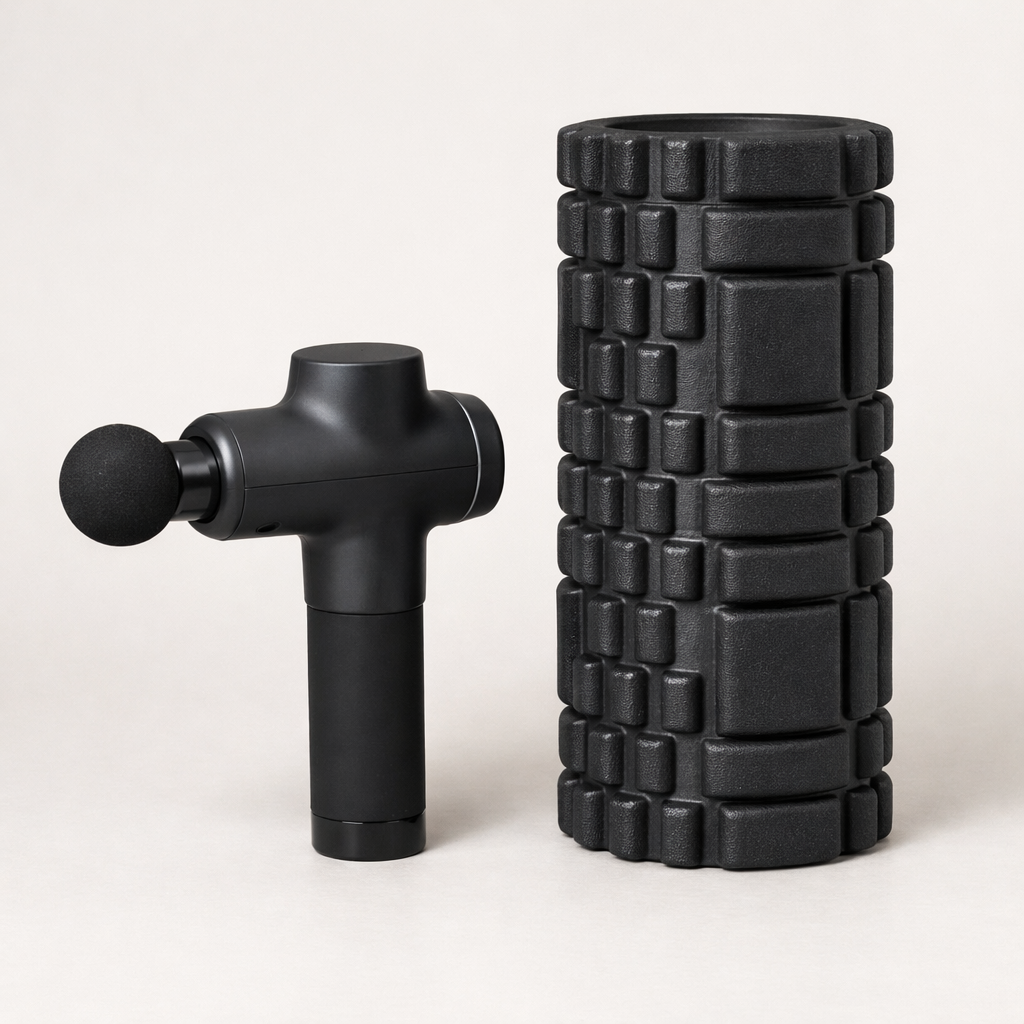
Trying to decide between a massage gun and a foam roller? The right choice depends on whether you need targeted relief or full-body recovery. Here’s a simple breakdown to help you choose the best option for your needs.
Massage guns and foam rollers are two of the most common self-recovery tools used today. Both are marketed to help reduce muscle tightness, improve mobility, and support recovery after workouts or physically demanding days. But when you compare a massage gun vs foam roller, which one is actually better?
The honest answer: it depends on your goals, how your body responds to pressure, and how you plan to use the tool. A foam roller can be extremely effective for large muscle groups and general tightness, while a massage gun can be more convenient for targeted areas and people who prefer adjustable intensity.
Below, we break down how each tool works, the main differences, what research generally suggests, and how to decide which option makes the most sense for you.
How a Massage Gun Works
A massage gun is a handheld device that delivers rapid, repetitive pulses into soft tissue. This is commonly called percussion therapy. Instead of sustained pressure (like foam rolling), massage guns create short bursts of mechanical pressure delivered at a selected speed and depth.
Many people use massage guns during:
- Warm-ups (to help muscles feel less stiff before activity)
- Cooldowns (to support relaxation after activity)
- General comfort routines (especially after long periods of sitting or standing)
Common advantages of massage guns include:
- Adjustable intensity (speed and sometimes depth)
- Targeted application to specific areas
- Less physical effort than foam rolling
- Convenience for hard-to-reach muscles
If you’re new to the category, start with our beginner guide explaining what a massage gun is and how it works.
How a Foam Roller Works
Foam rolling is a form of self-myofascial release that uses body weight and sustained pressure against a cylindrical roller. While the term “myofascial release” can sound clinical, foam rolling is basically controlled pressure applied to muscle and surrounding tissue to help temporarily reduce stiffness and improve range of motion.
Foam rolling is commonly used to:
- Target large muscle groups
- Reduce the feeling of tightness after workouts
- Improve short-term mobility (especially when paired with movement)
Common advantages of foam rollers include:
- Low cost and widely available
- No charging, batteries, or settings
- Effective for larger areas like quads, glutes, and hamstrings
- Encourages slower, sustained pressure that some people prefer
The tradeoff is that foam rolling requires more physical effort and positioning. Some people also find it uncomfortable at first, especially if they apply too much pressure too quickly.
Massage Gun vs Foam Roller: The Key Differences
1) Pressure Style: Pulses vs Sustained Pressure
- Massage gun: rapid pulses into tissue
- Foam roller: sustained pressure using body weight
Some people prefer the “fast and targeted” feel of percussion. Others respond better to slower pressure that they can gradually increase.
2) Precision and Targeting
Massage guns tend to be better for precise targeting, especially for:
- Calves
- Upper traps
- Forearms
- Glutes (smaller target areas)
- Around shoulders (with care)
Foam rollers tend to be better for broad coverage, especially:
- Quads
- Hamstrings
- Glutes
- Upper back (for some individuals)
- IT band area (with caution and comfort)
If your main goal is addressing a single tight spot, a massage gun often feels easier to use. If your goal is working through generalized tightness across large muscle groups, foam rolling can be more efficient.
3) Ease of Use and Effort
Massage guns require less physical work. You position the device and gently guide it.
Foam rollers require:
- Getting into the right position
- Supporting body weight
- Controlling pressure with arms/legs/core
- Staying steady on the roller
For beginners (or people with limited mobility), massage guns often feel easier to integrate into a routine.
4) Intensity Control
Massage guns usually offer intensity control through:
- Speed levels
- Different attachment heads
- Pressure applied by the user
Foam roller intensity is controlled by:
- Your body weight
- Positioning
- Rolling speed
- Roller firmness (soft vs firm vs textured)
Many people accidentally make foam rolling too intense by putting full body weight onto the roller immediately. If foam rolling hurts sharply rather than feeling like manageable pressure, it’s usually too much.
5) Cost and Value
- Foam rollers are generally inexpensive and last a long time.
- Massage guns typically cost more due to motors, batteries, and build quality.
If budget is a primary factor, foam rolling is often the easiest first step. If convenience and targeting are priorities, a massage gun can be worth the extra cost.
If you’re leaning toward a massage gun, compare beginner-friendly options in our Best Massage Guns for Beginners (2026) buyer guide.
Which Is Better for Muscle Soreness?
Both tools are commonly used to manage post-workout soreness, especially delayed onset muscle soreness (DOMS). In general, research tends to support that both foam rolling and percussion therapy can provide short-term improvements in flexibility and perceived soreness for some people.
That said, outcomes vary a lot depending on:
- The muscle group
- Pressure tolerance
- Timing (before vs after exercise)
- Duration and technique
- Individual response
Neither tool should be expected to “erase soreness” or replace recovery fundamentals like sleep, hydration, nutrition, and smart training load.
If you want the evidence-based view on percussion therapy specifically, see our research breakdown: Do Massage Guns Actually Work? What Research Says.
Which Is Better for Mobility and Range of Motion?
For many people, both foam rolling and massage guns can help with short-term mobility—especially when used before training or paired with light movement afterward.
A practical approach many people use:
- Apply light rolling or percussion for 30–60 seconds per muscle group
- Follow with active movement (bodyweight squats, lunges, dynamic stretching)
If your goal is improving mobility right before exercise, shorter and lighter sessions are usually more helpful than long, aggressive sessions.
Safety Considerations
Both tools are generally low risk for healthy adults when used properly. Most problems happen when people use too much intensity, stay on one area too long, or use the tool on inappropriate regions.
Massage gun caution points:
- Avoid direct use on joints and bones
- Avoid the front/side of the neck
- Use extra caution with medical conditions, recent injuries, or circulatory issues
For a full safety breakdown, see: Are Massage Guns Safe? Risks, Contraindications & Proper Use.
Foam rolling caution points:
- Don’t apply high pressure immediately
- Avoid sharp pain or nerve-like sensations
- Be cautious with areas that feel inflamed or injured
If you have an existing injury or medical condition, conservative use and medical guidance are the safest approach.
When a Massage Gun Is the Better Choice
A massage gun may be the better option if you:
- Want targeted relief in specific areas
- Prefer adjustable intensity
- Have difficulty supporting body weight on a roller
- Want a faster, more convenient routine
- Need help reaching muscles like upper back, calves, or shoulders (carefully)
Massage guns also tend to work well for people who want a quick “maintenance” routine—short sessions that fit into daily life.
When a Foam Roller Is the Better Choice
A foam roller may be a better choice if you:
- Want a low-cost recovery tool
- Prefer sustained pressure you can control gradually
- Mainly target large muscle groups (quads, hamstrings, glutes)
- Don’t mind the physical effort required
- Want a tool that never needs charging
Foam rollers are also useful for building body awareness and learning how muscles respond to pressure over time.
Can You Use Both?
Yes — and many people do.
A simple combined approach:
- Foam roller for large muscle groups (quads, hamstrings, glutes)
- Massage gun for targeted spots (calves, upper traps, tight areas)
This “broad then targeted” routine can feel more complete without taking much extra time.
Example routine (10 minutes total):
- Foam roll quads: 60 seconds each side
- Foam roll hamstrings: 60 seconds each side
- Massage gun calves: 45 seconds each side
- Massage gun upper traps: 30 seconds each side
- Light movement for 2 minutes
The best recovery tool is ultimately the one you’ll use consistently and safely.
Frequently Asked Questions
Is a massage gun better than a foam roller?
Massage guns are better for targeted relief and ease of use, while foam rollers are better for full-body muscle work and affordability. The best option depends on your recovery goals and preferences.
Do foam rollers actually work for muscle recovery?
Foam rollers can help reduce muscle tightness, improve flexibility, and support recovery when used consistently. They are most effective as part of a broader recovery routine.
Are massage guns worth the extra cost?
Massage guns offer convenience, adjustable intensity, and targeted relief, which can make them worth the cost for many users—especially beginners. If you’re considering one, you can explore our guide to the best massage guns for beginners to compare easy-to-use and quiet options.
Can you use a foam roller and massage gun together?
Yes, many people use both tools together. Foam rollers are useful for large muscle groups and warm-ups, while massage guns are better for targeted muscle relief and post-workout recovery.
Final Verdict: Massage Gun vs Foam Roller
There isn’t one universally “better” choice.
- Massage guns are convenient, targeted, and adjustable.
- Foam rollers are affordable, effective for large muscle groups, and don’t require charging or settings.
Recommended Recovery Tools
If you’re ready to buy, these are our top beginner-friendly recovery tool recommendations.
🏆 Best Beginner Massage Gun
Theragun Relief
Balanced performance, quiet operation, and beginner-friendly controls make the Theragun Relief an excellent choice for first-time users.
👉 Check price & availability on Amazon →
🟦 Best Foam Roller
TriggerPoint Grid 1.0 Foam Roller
The multi-density surface provides comfortable pressure for beginners while helping relieve muscle tightness, improve mobility, and speed recovery.
👉 Check price & availability on Amazon →
If you’re deciding which to buy first, foam rolling is often a low-risk starting point. If you value convenience and precision—or foam rolling feels too difficult or uncomfortable—a massage gun may be the better fit.
If you’re considering a massage gun, compare beginner-friendly models in our 2026 buyer guide. And if you want the evidence-first answer, start with what research says about massage gun effectiveness.

SignalWorth Editorial Team consists of experienced product researchers and writers focused on in-depth comparisons, testing analysis, and consumer education. Our reviews are based on hands-on evaluation, technical specifications, industry research, and real-world use cases. We prioritize transparency, editorial independence, and reader trust in every guide we publish.